Planetary War – GrahaYuddha
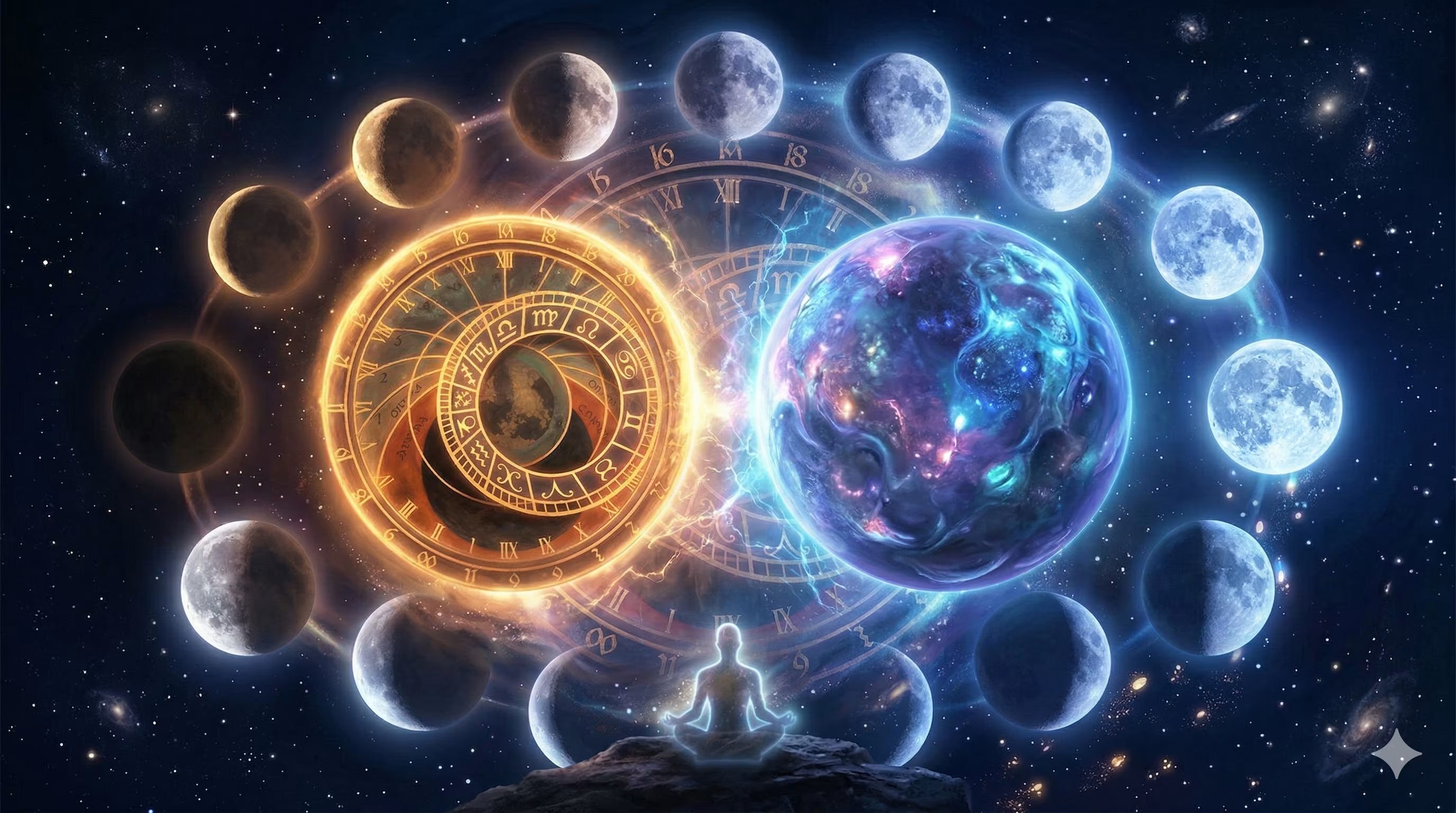
In the language of Jyotiṣa, the cosmos is not silent,it is a living संवाद (dialogue). Among its more intense expressions is the phenomenon known as graha-yuddha (planetary war), where two grahas come into such close proximity that their influences appear to contend for dominance. While the phrase “war” may evoke conflict in a literal sense, the Vaidika understanding is subtler, pointing not merely to outer events but to inner tensions within consciousness itself.
Traditionally, graha-yuddha occurs when two of the non-luminary planets viz. Maṅgala, Budha, Guru, Śukra, or Śanioccupy nearly the same degree in a single rāśi. Classical texts like the BṛhatParāśaraHorāŚāstra describe this condition with precision, even outlining methods to determine the “victor” based on apparent brightness (dīpti) or positional strength. Yet, beyond technicalities, what is truly at play is an overlap of energies - two distinct tattvas attempting to express themselves through the same field.
A traditional idea echoes this dynamic:
“grahāṇāṁsaṅgamoyatratatraphala-virodhitā”
“Where planets closely conjoin, there arises a contradiction in their results.”
This phala-virodha conflict of outcomes is not necessarily destructive; rather, it reflects complexity. For instance, when Maṅgala (agni-tattva, action, assertion) and Śukra (jala-tattva, harmony, desire) engage in yuddha, the individual may feel torn between impulse and refinement, passion and balance. Such inner friction, though uncomfortable, often becomes the ground for growth.
From the lens of guṇa, planetary wars frequently indicate a disturbance in the natural balance of sattva, rajas, and tamas. One graha may amplify rajas (activity, restlessness), while another invokes sattva (clarity) or tamas (inertia). When these forces collide without harmony, the mind (manas) experiences ambiguity, decisions become harder, motivations unclear. Yet this very tension can sharpen awareness, much like the friction that produces fire.
It is also worth noting that not all grahas participate equally. The luminaries Sūrya and Candraare excluded from graha-yuddha in the classical sense, as they represent more foundational principles of consciousness and identity. Their role is not to “compete,” but to illumine. The wars, therefore, belong to the realm of the pañca-grahas, reflecting the dynamics of intellect, desire, discipline, expansion, and action within the human psyche.
On an adhyātmika level, graha-yuddha can be seen as an external mirror of internal संघर्ष (struggle). Every individual carries within them multiple drivessome elevating, others binding. When two strong impulses arise simultaneously, each demanding expression, the result is often confusion or inner conflict. Jyotiṣa does not merely predict this; it invites us to witness it consciously.
Another reflective line often contemplated in this context is:
“yadbhāvam tad bhavati”
“As is the inner state, so becomes the experience.”
Thus, the “victory” of a graha is not always about suppression of the other, but about integration. A strong Guru prevailing over Budha in war may incline one toward wisdom over analysis but ideally, life calls for both. The deeper teaching, therefore, is not domination, but alignment.
In practical life, periods of graha-yuddhawhether in a natal chart or through transit (gochara) may manifest as decision fatigue, conflicting priorities, or emotional turbulence. Yet these are also moments ripe for viveka (discernment). When approached with awareness, they can refine judgment, deepen patience, and reveal hidden layers of one’s nature.
Ultimately, Jyotiṣa never intends to instill fear. Even yuddha in the heavens is part of a larger ṛtathe cosmic order. What appears as conflict is often a movement toward higher harmony, though not immediately visible.
Thus, graha-yuddha is less about celestial battle and more about the choreography of energiesan invitation to observe, to balance, and to evolve. When understood in this light, even conflict becomes a teacher, guiding the seeker from fragmentation toward inner coherence, from tension toward a more luminous integration of self.